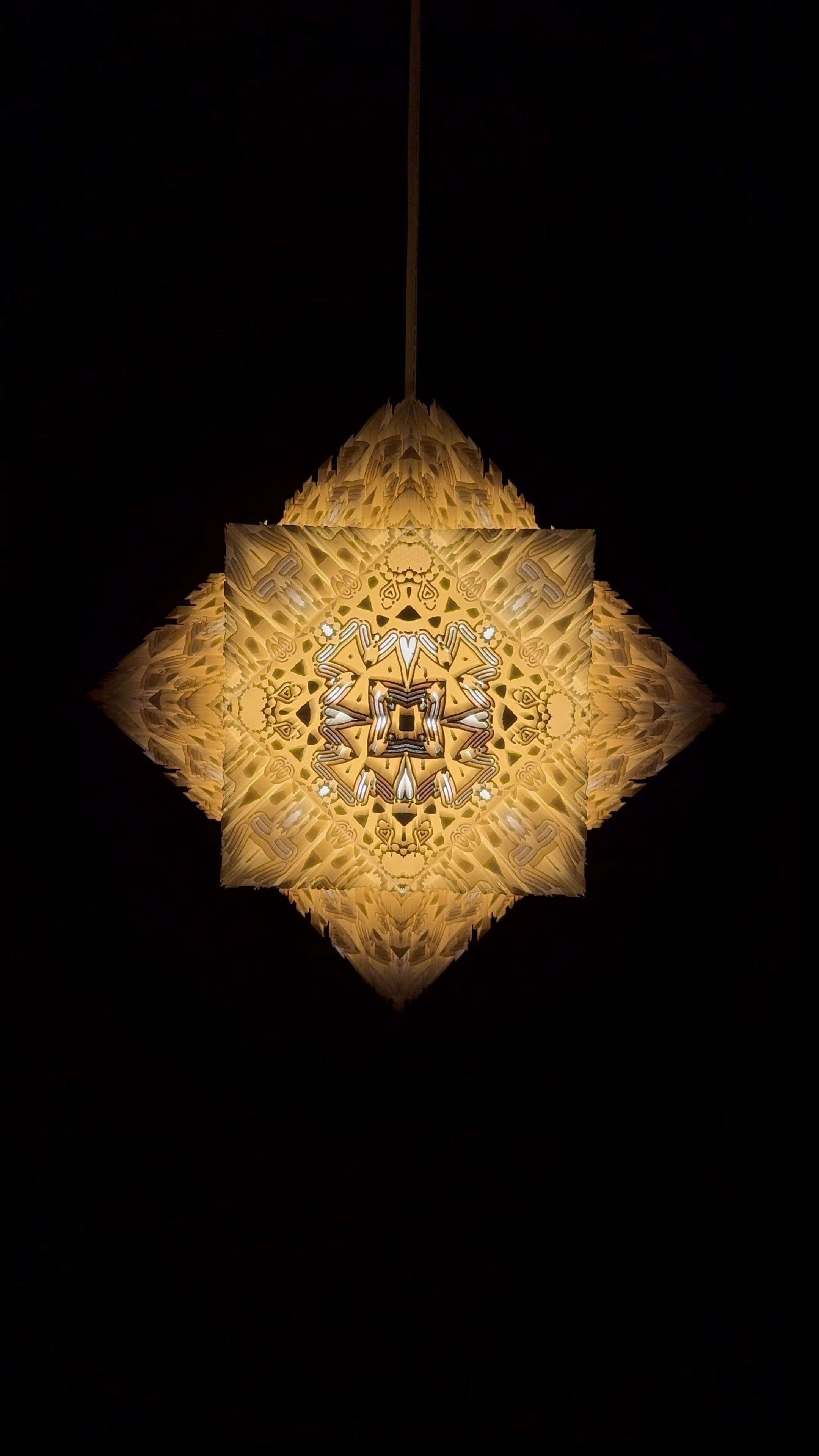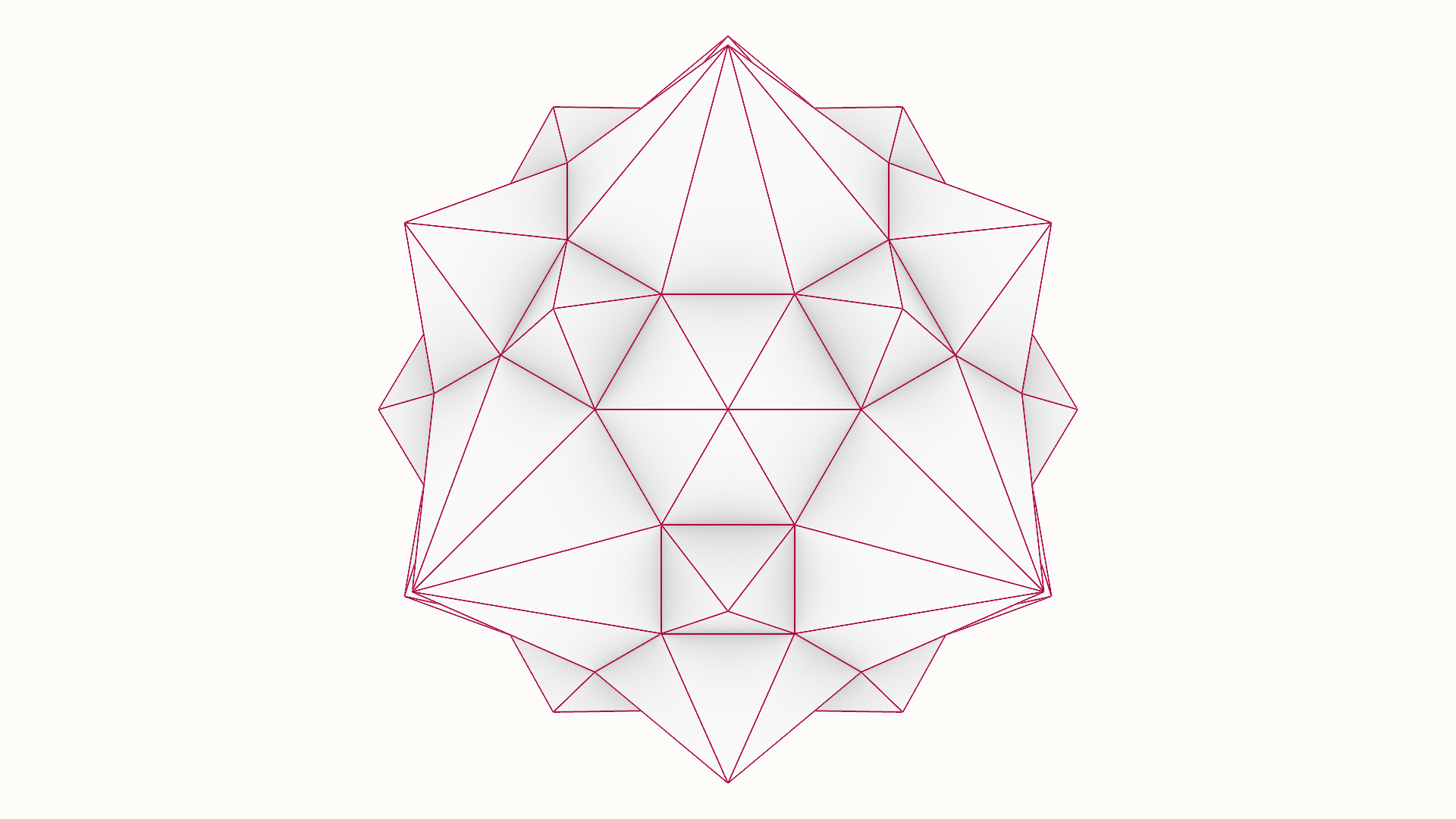
Envelope Extrusion:
A New Polyhedral Transformation
A geometric discovery from the process of making
This discovery began inside a fabrication problem.
I was developing a custom Grasshopper/Rhino script for building modular, 3D-printable polyhedral light sculptures. The script needed to take a known polyhedron, break it into buildable face-based modules, and generate cutting shapes that could be assembled into a physical object.
At first, the goal was practical: make a system that could produce accurate parts for complex geometric sculpture.
But while building the script, a new geometric behavior appeared.
The software was not simply decorating existing polyhedra. It was producing a consistent transformation: each input polyhedron generated a new closed form, with its own proportions, symmetries, and measurable structure. The operation worked across Platonic solids, Archimedean solids, and even shapes where classical stellation theory does not apply.
I now call this operation the Envelope Extrusion, written as:
E(P)
where P is the original polyhedron.
The discovery is important because E(P) is not just a style of modeling. It appears to define a distinct polyhedral transformation
What E(P) doesAt a visual level, the Envelope Extrusion takes every face of a polyhedron and replaces it with a pyramid-like structure.
But the key point is this: The pyramid apex is not chosen arbitrarily.
It is not simply pulled outward by a fixed distance.
It is not placed at the face center.
It is not created by a standard “kis,” “kleetope,” or stellation operation.
Instead, the apex of each pyramid is determined by the surrounding geometry of the neighboring faces.
That means the shape of each new point depends on the local structure of the original polyhedron.
The result is a new closed surface made from triangular faces. Each original face becomes the base region for a new pyramid, and the full collection of these pyramids forms the transformed object: P⟶E(P)
The operation is deterministic: the same input polyhedron produces the same output every time.
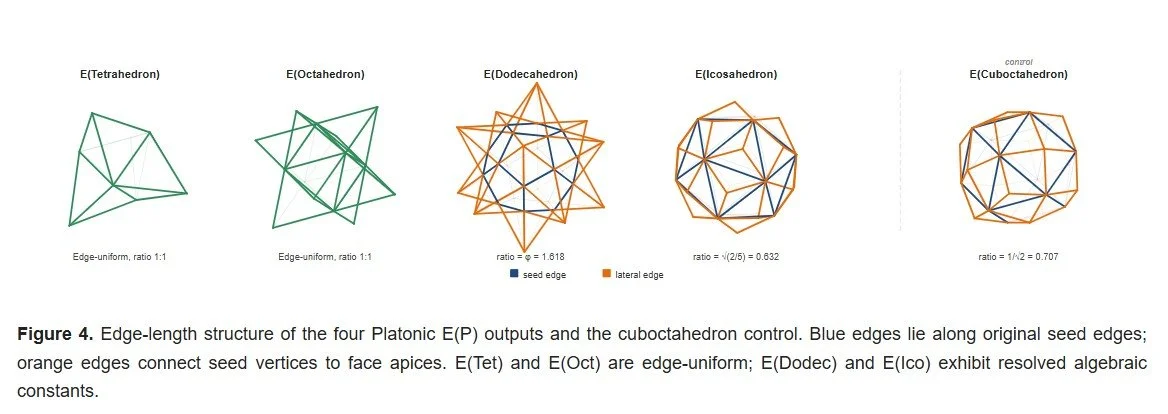
For each face of the original polyhedron, the script constructs a new pyramid.
To find the apex of that pyramid, the algorithm looks at the edges of the face. Each edge is shared with a neighboring face. For each neighboring face, the script builds a directional ray that points toward the shared edge.
The ray rule depends on whether the neighboring face has an odd or even number of sides.
How the Construction Works
The ray begins at the midpoint of the shared edge.
The direction of the ray is determined by the vertex of the neighboring face that is farthest from that shared edge.
In simple terms:
For an odd-sided neighbor, the ray points from the farthest opposite vertex toward the shared edge midpoint.
If the neighboring face has an odd number of sides
An even-sided face does not have a single opposite vertex in the same way. Instead, it has an opposite edge.
So the ray again begins at the midpoint of the shared edge, but its direction is determined by the midpoint of the neighboring face’s farthest opposite edge.
In simple terms:
For an even-sided neighbor, the ray points from the midpoint of the opposite edge toward the shared edge midpoint.
If the neighboring face has an even number of sides
Once all of these rays are created around a face, the script compares them in pairs.
For every pair of rays, it finds the points where the rays come closest to one another. It filters out bad or backward intersections, then averages the remaining closest-approach points.
That average point becomes the apex of the pyramid.
So the apex is not a decorative point. It is a geometric consequence of the surrounding face structure.
That is the heart of the Envelope Extrusion.
How the apex is found
The Important Distinction: The Bisector Is a Result, Not the Definition
One of the surprising behaviors of E(P) is that the walls of the new pyramids often approximate the dihedral bisector directions of the original polyhedron.
In other words, the triangular walls created by the operation tend to align with angle relationships already present in the seed form.
This is an important observation. But it is not the definition of the operation.
The Envelope Extrusion is not defined by intersecting bisector planes. It is defined by the ray construction and averaging process described above.
That distinction matters because the bisector-like behavior emerges from the algorithm. It is not manually imposed.
That is one reason I consider the operation mathematically interesting: a simple local rule produces a larger global structure with recognizable geometric order
Why This Creates a New Class of Shapes
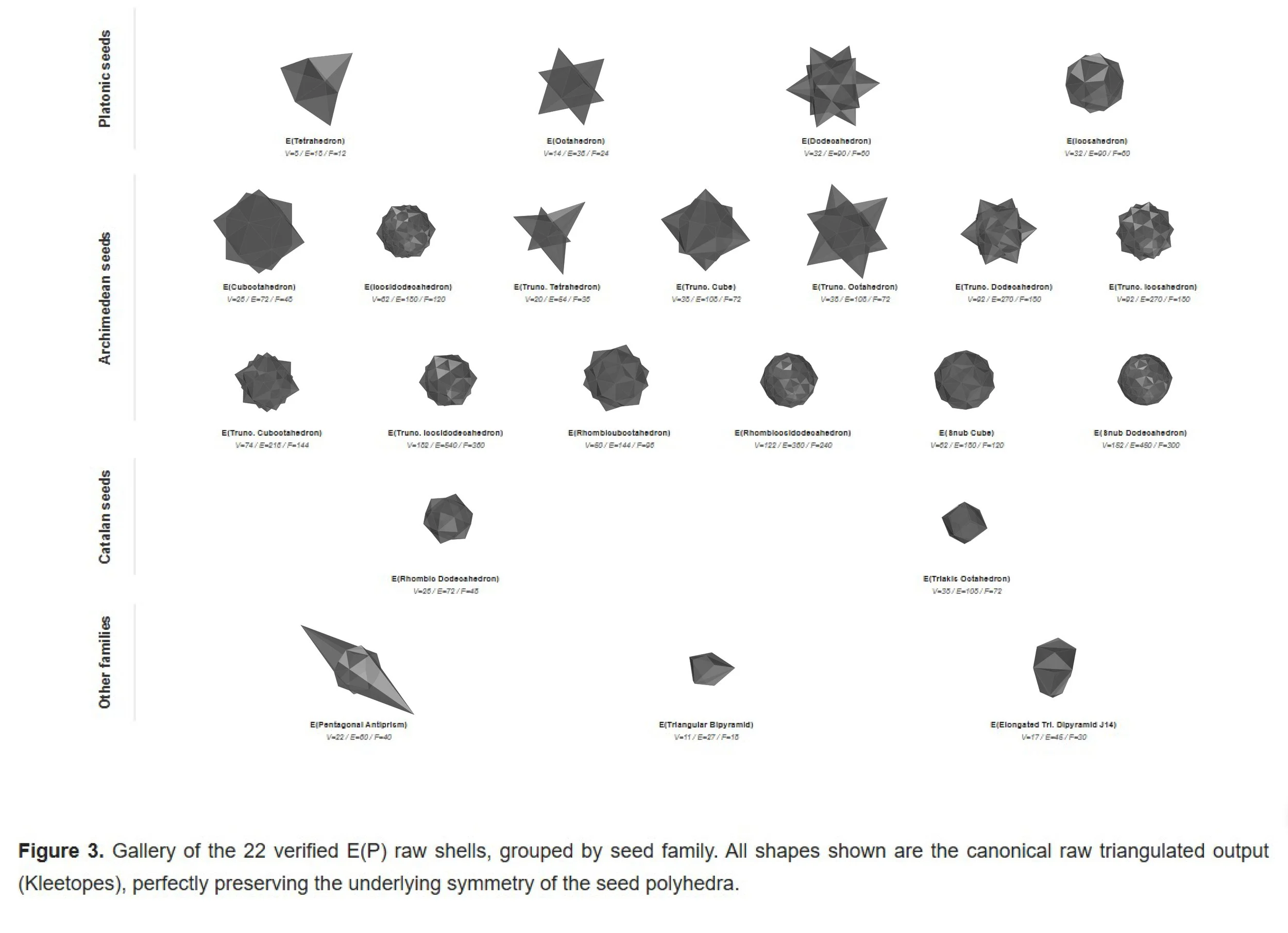
The most important claim is not that the shapes are visually unusual. The important claim is that the operation creates a repeatable family of polyhedral forms that do not fit cleanly into existing transformation categories.
Given a seed polyhedron P, the Envelope Extrusion produces a new closed triangular surface E(P). This can be done systematically across families of polyhedra.
That means the discovery is not just one new object. It is a transformation, and a discovery of a new class of shapes.
For every valid seed, there is a corresponding envelope-extruded form:
P1→E(P1)
P2→E(P2)
P3→E(P3)
and so on.
This opens the door to an entire catalogue of forms: Envelope Extrusions of Platonic solids, Archimedean solids, Catalan solids, Johnson solids, and potentially many other convex polyhedra.
Some outputs resemble known solids.
Some share the same face and edge counts as known solids but differ metrically.
Some appear to occupy territory that classical stellation cannot reach.
That is where the discovery becomes especially interesting
Why This Matters for My Practice
For me, the Envelope Extrusion changes the status of the work.
It means the sculptures are not simply inspired by geometry. They are part of an active geometric system.
The forms are not arbitrary. They come from a repeatable transformation. That gives the work a kind of structural credibility that is important in mathematical art and computational design.
In the art field, especially in geometry-based sculpture, there is a meaningful difference between using mathematical imagery and contributing a new geometric process.
The Envelope Extrusion gives me a process that is both visually powerful and intellectually generative.
It strengthens the work as art because the forms have internal necessity. They are not just chosen for appearance. They are discovered through a rule.
That is the kind of structure I am most interested in: beauty that comes from constraint.